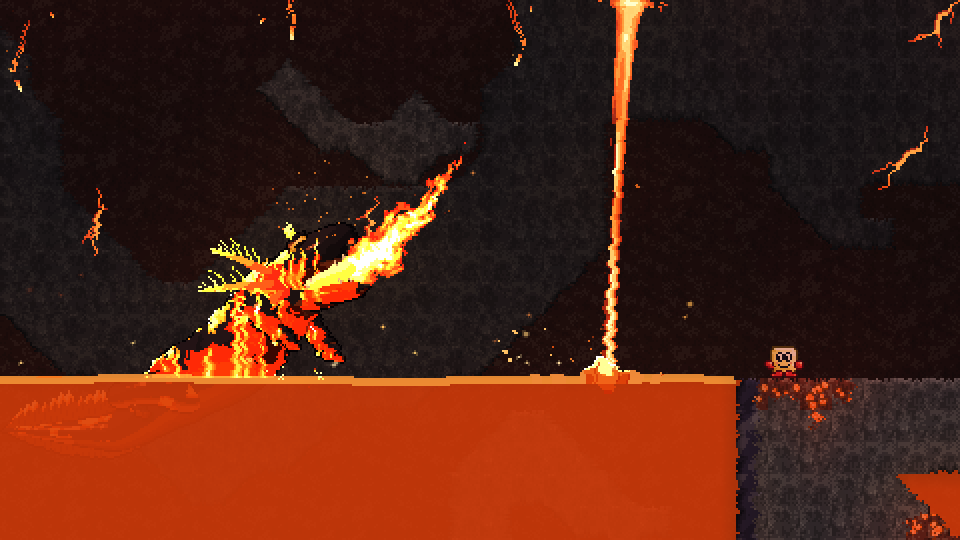
In October three bosses woke up under the forest, each in a hall of its own and each deeper than the last: the Rootbreaker at about 110 meters, the Starsnout at 260 and the Firegill at 331, at the very bottom of the world. Here's how we dreamed them up and made them. No code, we promise.
What they have in common
- A boss sleeps in its hall until a player walks in; then its health bar and the fight music appear.
- Every fight has three parts: at half health and at a quarter, the boss changes and gets angrier.
- Every strong blow can be seen coming, and a jump or a step back saves you.
- The more players in the hall, the more health the boss has. If the hall empties, it goes back to sleep and heals.
- A defeated boss returns after three game days. The server hands out the reward: 50,000, 100,000 and 200,000 coins, plus a trophy for your first win.
- Each has a few dozen sounds of its own, all made inside the game.
The Rootbreaker, Keeper of the Roots
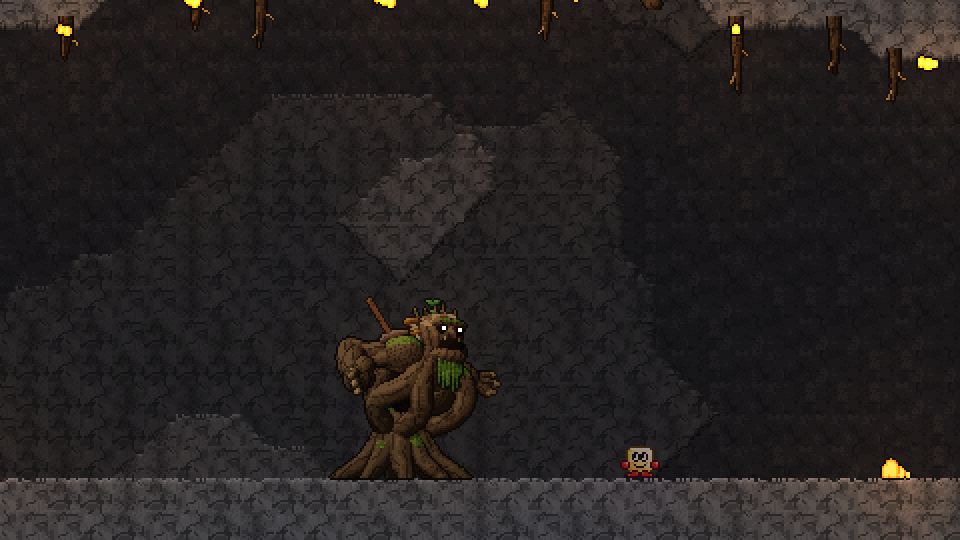
The Rootbreaker came first. We weighed a cave bear, a stag beetle and a mushroom queen, but the winner was a colossus made of the roots of a giant tree. Its head is a stump, its eyes are amber, and behind the bark on its chest is a cage of roots with an amber heart inside. Someone's pickaxe is still stuck in its shoulder.
At first it's rooted to the floor: it sweeps its arm, slams both fists down so a wave runs along the floor, sends roots up under your feet and hurls boulders. At half health the bark on its chest bursts, the heart is laid bare and blows to it count double, and the Rootbreaker tears its legs out of the floor and comes after you. At a quarter it roars at the ceiling, and roots and stones rain down. Win, and the heart rises from a heap of roots and bursts into light.
We didn't draw a single frame of it by hand. It's built from a few hundred simple 3D shapes, balls along the roots and ovals for the burls, and every frame it's painted into pixels anew, lit from the top left. That's why the bark and the moss move with its body when it turns.
The blows were the hardest part. At first its elbows jumped, as an arm took a shortcut straight through the body. Now each arm swings in an arc around the shoulder, and a fast blow leaves a see-through trail.
The Starsnout, Lord of the Burrows
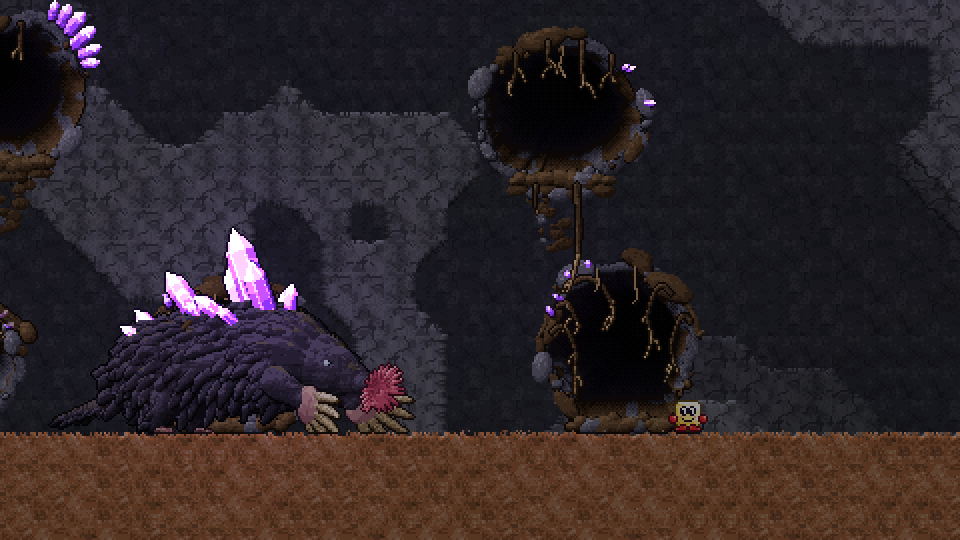
The second is a star-nosed mole the size of a house. It's blind and hunts by the trembling of the ground: it hears you run, land from a jump or drill. If you stand still, it has to feel around for you.
It rakes with a paw, flails in a flurry of blows and kicks earth at anyone behind it. It dives into the floor and swims under it as a mound of earth that swells where the mole is about to come up, then tosses you into the air. It ducks into one of six burrows in the wall and bursts out of another. When it comes up, it freezes and listens, wiggling the star on its nose. That's the moment to strike: the star takes double damage.
At half health the amethysts on its back crack with light, stones fall from the ceiling, amethysts burst up along the floor and the mole drops on you from the upper burrows. At a quarter it shrieks, and rings of sound spread out from it.
The first version came out "too bald," so the mole grew hundreds of tufts of fur. We dropped a spiky porcupine look, moved bigger crystals to its back, gave it real mole hind feet and long separate claws, and paint its 22-ray star on its own.
The most interesting part is the earth. At first pits and mounds were drawn as ovals and shrinking circles, and it looked fake. We threw that away and made the floor out of grains, each one a pixel of its own. They fly, fall, roll down steep slopes and settle into heaps. The mole digs a funnel paw by paw, the mound above it is the floor's own earth pushed up from below, and the rubble over the exits crumbles away after the win.
In the first tests the mole hid in its burrows far too often. We made it angrier.
The Firegill, Mother of Fire Salamanders
The third boss lives in a lake of lava. There its skin is white-hot, and a sword or an arrow barely hurts it. On the stone it cools: a crust creeps over it, its spots go dull, and the colder it gets, the more your blows hurt. So it comes out to hunt and goes back into the lava to warm up. We had a coal elk in mind too, but the fire salamander won.
From the lava it lunges at anyone on the shore, spits lava and slaps the lake so a wave washes over the shores. On the stone it bites, lashes its tail, climbs the wall, crawls upside down along the ceiling and drops on you. Before it spits, its throat puffs out: hit it there, and it chokes. At half health it sheds its skin, leaving the empty husk behind, and the new skin is quicker and hotter. At a quarter the lava floods the low shores, and only the high ledges by the walls are safe.
Fire painted as tongues
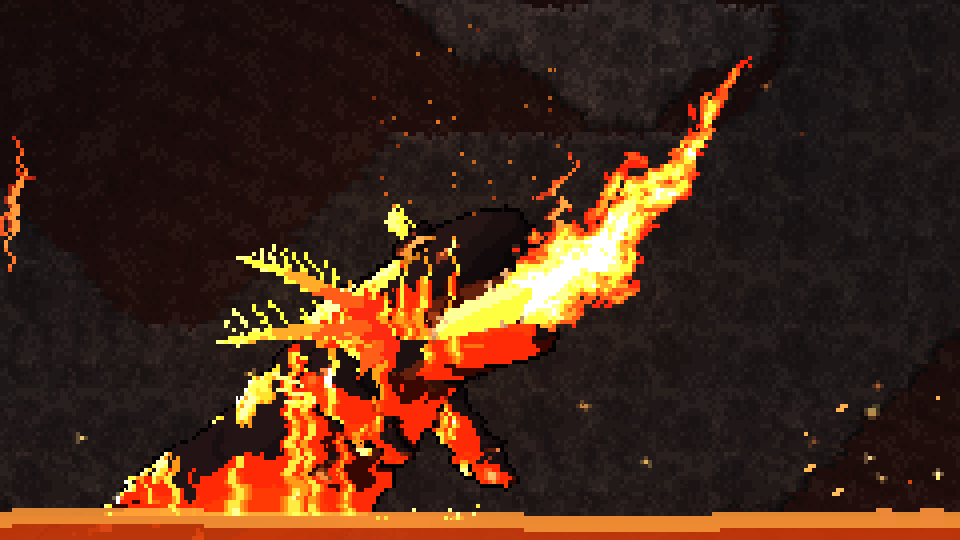
We first built the fire from its mouth out of flying particles, and it looked nothing like fire. So we started painting the flame the way artists do: one tongue from the gap between the jaws, ragged at the edges, breaking into smaller tongues and curling upward, because fire is lighter than air. It's white-gold at the root, then orange and red, with tips that trail off into smoke. Only the sparks are still particles.
What we changed after testing
We filmed its moves frame by frame to hunt down jerky motion. Here's what we fixed:
- Its colors changed all at once. Now each ember pixel goes out at its own temperature.
- On a wall it moved like a stiff clock hand. Now its spine follows the stone.
- The wave was a hump of blocks. Now it's a real surge of lava.
- Lava now runs off its body.
- Its spit flew out from above the mouth and passed through walls. Not anymore.
- We removed the lava plugs over the exits: you can always leave its hall.
If you're heading down, bring a good weapon and don't forget to jump. Good luck!